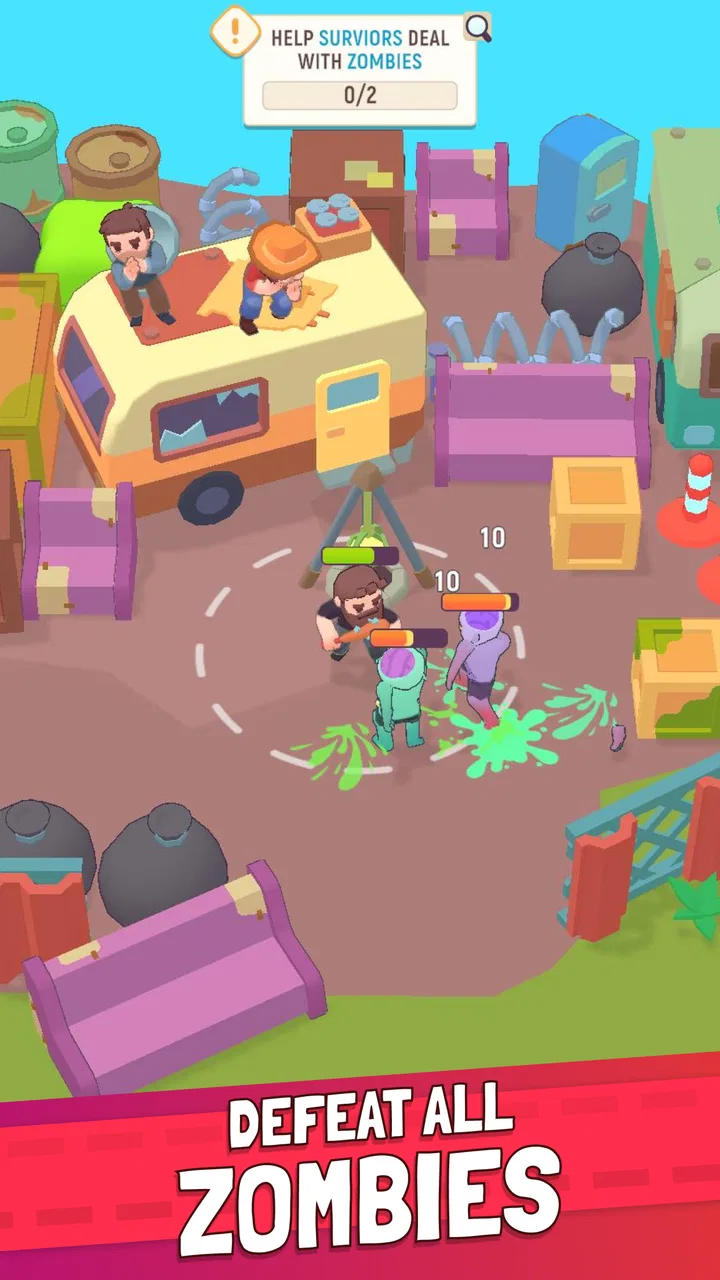
Last Stronghold: Idle Survival
- 4.4
- Rating
- 10.00M
- Installs
- Free
- Price

 Analysis by App-foxy
What kept me playing Last Stronghold: Idle Survival was not simply the zombie setting. It was the way the game turns survival into a decision about where limited resources should go next. I am constantly choosing between making my stronghold safer, gathering what is needed to keep progress moving, and preparing for the next threat. That focus gives this role-playing game a clearer identity than a basic idle title that only asks me to collect rewards and tap an upgrade button.
At its heart, the game asks me to build a refuge after a collapse, attract survivors, and protect the settlement from zombies. The premise is easy to understand, but the useful part is how those goals compete for attention. A stronger base is reassuring, yet every improvement also makes me think about whether I am developing the right part of the settlement at the right moment. I found that tension more interesting than the setting alone.
SayGames Ltd keeps the presentation accessible, and the game is free to start. It belongs to the role-playing category, although its experience is much lighter than a traditional character-driven RPG. I would describe it as an approachable survival-management game with idle elements rather than a deep adventure built around dialogue, exploration, or complex party combat.
You May Also Like

 Blood Strike: 2.5 Anniversary
Blood Strike’s Loadouts Turn Every Drop Into a Tactical Gamble
A close look at Blood Strike’s custom loadouts: how fast access to signature weapons reshapes its battle royale rhythm, rewards preparation, and narrows the gap between fights.

 Pandora - Music & Podcasts
Pandora’s Music Is Easy to Start, but Harder to Recover
Pandora’s strength is its low-effort path from a seed to a station. Its weak spot is how much confidence it asks you to place in connection, setup, and quiet recovery.

 8 Ball Pool
 Is Built on Rivalries, Rematches, and Routine
A close look at the rivalries, rematches, shared routines, and unanswered safety questions that turn a quick pool match into a persistent mobile community.

 Samsung Music
’s Quiet Strength Is Playing What You Already Own
Its reach comes less from spectacle than from dependable access to a personal library. That simplicity is both the app’s strongest retention engine and its ceiling.

 AccuWeather: Weather Radar
AccuWeather Review: A Quick, Clear Forecast for Everyday Decisions
For everyday plans, the best forecast is the one you can understand quickly. AccuWeather makes rain timing, radar, and local conditions easy to act on, with a few trade-offs.

 Hill Climb Racing
Why Hill Climb Racing Still Turns Crashes Into One More Run
A tiny car, a bumpy hill and one more upgrade: Hill Climb Racing keeps resurfacing because its simple chaos makes every near-miss feel personal.
More From Our News Desk
View All News


Why the stronghold is the real capability
The central capability is the stronghold itself: it is both the place I am trying to improve and the reason every resource matters. Instead of treating construction as a decorative side activity, the game makes the settlement the center of my progress. Loot supports development, development helps attract survivors, and the growing community gives me something worth defending.
This creates a useful loop. I do not gather materials just to make a number bigger. I gather them because the next improvement can change how comfortable the following stretch feels. That makes short play sessions worthwhile. I can open the game, collect what has accumulated, make one considered improvement, and leave without feeling that I needed to spend a long uninterrupted evening there.
The idle structure is especially helpful when I want a game that respects an irregular schedule. I can return after being busy and immediately have something to manage. However, I would not mistake that convenience for complete automation. The interesting choices still come from deciding what to prioritize and when to stop spending resources on one area so another can catch up.
The strongest part of the design is the trade-off between immediate comfort and long-term readiness. A quick improvement may help me progress now, while saving resources for a more meaningful development can make the next cycle smoother. The game does not need a complicated rulebook to create that pressure; the settlement itself gives every decision a practical context.
How progression feels during ordinary play
My usual session begins by checking the stronghold rather than rushing directly into action. I look at what has accumulated, see which improvement is within reach, and consider whether the settlement is ready for another push. This small routine is one reason the game works well as a casual role-playing experience. There is enough structure to give me a plan, but not so much that I need to remember a huge collection of systems.
The survivor element also gives the base a sense of purpose. Attracting people is not just a cosmetic milestone in my mind; it makes the stronghold feel like a community that needs support. That changes how I view resources. An upgrade is not only a personal power increase. It is part of making the refuge more capable of handling what comes next.
I recommend resisting the urge to spend everything as soon as a reward appears. Holding back briefly can be useful when two improvements are close together, because the better choice may depend on which one removes the bigger bottleneck. This is one of the less obvious lessons of the game: idle rewards feel generous when collected, but they become more valuable when I treat them as a small budget rather than free money.
Another practical habit is to use short visits for maintenance and longer visits for decisions. On a quick break, I can collect resources and make a safe upgrade. When I have more time, I can compare the needs of the settlement and think about whether I am building for immediate progress or future stability. Separating those two kinds of sessions prevents me from making rushed choices simply because I opened the app for a minute.
The best everyday scenario for it
This game suits the kind of player who wants a survival theme without committing to a demanding action game. For example, I can imagine playing it during a commute, while waiting for an appointment, or between larger tasks at home. I check the stronghold, make a couple of decisions, and close it again. The game gives that brief visit a clear beginning and end instead of requiring constant attention.
It also works for someone who enjoys the feeling of rebuilding after disaster but prefers management to direct combat. The appeal comes from watching a fragile refuge become more organized and better prepared. If I want a story-heavy role-playing game with extensive conversations and carefully developed companions, this is not the right substitute. If I want a lighter survival loop that can fit around daily life, it is much more convincing.
My favorite way to approach it is to set a small objective before each session. I might decide that the visit is about strengthening one weak part of the stronghold, preparing for a new group of survivors, or simply collecting enough resources to unlock the next useful step. This prevents the idle format from becoming passive. The game is more enjoyable when I give each visit a purpose rather than tapping through rewards without thinking.
There is also a good fit for players who like gradual progress but dislike losing a run after one mistake. The stronghold gives the experience a persistent sense of development, so a quiet session still contributes to a larger project. That said, the relaxed pace may frustrate anyone who expects constant surprises or a fast stream of dramatic encounters.
Where it differs from usual role-playing alternatives
Compared with a conventional RPG, Last Stronghold puts less emphasis on controlling a hero through a long journey and more emphasis on maintaining a place. In a typical adventure game, I may focus on equipment, abilities, battles, and story choices. Here, the settlement is the main character in practical terms. Its condition determines how satisfying the next step feels.
Compared with a pure idle game, it gives the waiting period a more understandable reason. Resources are connected to a post-apocalyptic refuge, survivors, and defense, so the numbers have a setting around them. Still, players who enjoy highly detailed resource spreadsheets or complex optimization may find the management layer intentionally streamlined.
It also differs from action-focused zombie games. I am not choosing it for fast reflex challenges or an intense atmosphere built around constant danger. Its strength is the calmer rhythm of preparing, improving, and returning later. That makes it easier to fit into a busy day, but it also means the game cannot replace an action title when I want immediate excitement.
Trade-offs that matter before installing
The first limitation is the idle pacing itself. The game is convenient because progress can continue between visits, but that same convenience can make some moments feel slower than expected. When I want a lot of activity right now, collecting and upgrading may not provide enough variety. The experience depends on enjoying gradual development rather than demanding instant payoff.
The second trade-off comes from the free-to-play structure. The game costs nothing to begin, while optional in-app purchases range from $0.99 to $99.99 per item. I would approach those purchases carefully. The most satisfying decisions come from planning the stronghold, so spending should not replace that part of the experience. Anyone who prefers a completely fixed-price game should understand this model before settling in.
Another point is the age classification. It is rated Everyone 10+, which makes it broadly approachable, but the zombie theme still means it is not designed as a preschool experience. Parents should consider whether a light survival setting is suitable for the child using the device, even though the game is presented as an accessible title.
The game also requires patience with repetition. Returning to collect, deciding, and improving is the main rhythm, not a temporary phase before the “real” game begins. I enjoyed that consistency, but a player who quickly tires of repeating a resource loop may prefer a more mission-based RPG. This is a genuine dividing line: the stronghold is the attraction, not merely a menu between action sequences.
One useful way to avoid frustration is to judge progress by settlement goals rather than by how much happens in a single visit. If I expect every opening to deliver a major event, the idle format feels thin. If I treat each visit as one step in a longer rebuilding process, the pacing makes more sense. That change in expectation improved my experience more than any tapping routine.
Who gets the most from the stronghold loop
I think the best audience is someone who likes survival themes, visible base development, and manageable decisions. The game is especially suitable for players who want a role-playing label without the time commitment of a large campaign. It can also appeal to people who enjoy checking in throughout the day and seeing that their earlier choices have continued to matter.
It is less suitable for players who need deep character customization, a large narrative, or constant manual control. I would also point action fans toward a more combat-centered zombie game if their main goal is tension and reflex-based play. The stronghold loop is thoughtful rather than explosive, and its simplicity is both its advantage and its boundary.
The current version is 1.6.7, and the game runs on Android 8.0 or later. It has reached over ten million installs, with an average rating of 4.4 from around one hundred thirty thousand ratings and roughly two thousand five hundred written reviews. Those figures suggest that the accessible survival formula has found a substantial audience, but they do not change the basic advice: choose it for the settlement-management loop, not because you expect a full-scale console-style RPG.
I would also recommend it to someone who likes making small plans under pressure. The most rewarding moments are not necessarily the largest upgrades. They are the points where I notice a weak spot, save enough resources to address it, and see the stronghold become more prepared. That feeling is modest, but it is concrete, and it gives the idle structure a reason to hold my attention.
My final recommendation
Last Stronghold: Idle Survival is a good choice when I want a free, approachable game about rebuilding rather than surviving through nonstop action. Its defining strength is the stronghold-centered loop, where resources, survivors, and defense all point back to the same settlement. That focus makes the game easy to understand and surprisingly comfortable to play in brief sessions.
I would not recommend it to someone looking for a story-rich RPG or a demanding zombie battle game. The pace can feel repetitive, and the free-to-play purchase range means I would keep a close eye on spending. But for a player who enjoys gradual progress, short check-ins, and the satisfaction of turning a vulnerable refuge into a stronger one, it offers a clear and pleasant routine.
My advice is to play it deliberately: collect rewards, identify the settlement’s current weakness, and spend resources with the next useful improvement in mind. When I played that way, the game felt less like an automatic reward machine and more like a compact survival-management experience. That is where it works best, and it is the reason I would recommend giving it a try if that particular rhythm sounds appealing.
FAQs for Last Stronghold: Idle Survival
01What is the main objective of Last Stronghold: Idle Survival?
Last Stronghold: Idle Survival challenges players to build, manage, and defend their fortress against waves of enemies. The main objective is to strategically enhance your defenses, gather resources, and survive as long as possible against increasingly difficult threats. The game combines elements of strategy, resource management, and idle gameplay, providing a rich experience for players.
02How does the idle gameplay mechanic work in Last Stronghold: Idle Survival?
The idle gameplay mechanic allows players to progress even when they are not actively playing. In Last Stronghold: Idle Survival, your fortress continues to gather resources and fend off minor attacks automatically. This feature ensures that you can make progress and accumulate rewards, which can be used to upgrade your defenses and develop new strategies when you return to the game.
03Is Last Stronghold: Idle Survival free to play, and are there in-app purchases?
Yes, Last Stronghold: Idle Survival is free to download and play. However, the game does offer in-app purchases. These purchases can enhance gameplay by allowing players to acquire resources or special items more quickly. While not necessary to enjoy the game, these optional purchases can provide a boost to players looking to speed up their progress.
04What platforms is Last Stronghold: Idle Survival available on?
Last Stronghold: Idle Survival is available on both Android and iOS platforms. This ensures a wide accessibility for mobile gamers. Players can download the game from the Google Play Store for Android devices or the App Store for iOS devices, allowing them to enjoy the game on their preferred platform.
05What are some tips for beginners in Last Stronghold: Idle Survival?
For beginners, it's crucial to focus on balancing resource management and defense upgrades. Start by investing in resource-generating structures to ensure a steady income. Prioritize upgrading your walls and defensive units to withstand enemy assaults. Also, take advantage of the idle mechanics by checking in periodically to collect resources and plan your next upgrades strategically.
Pros
- Engaging idle mechanics for casual play.
- Rich graphics enhance the survival theme.
- Regular updates with new content.
- Easy to learn
- hard to master gameplay.
- Offline mode available for on-the-go play.
Cons
- In-app purchases can be expensive.
- Requires a stable internet for updates.
- Graphics may lag on older devices.
- Progress can feel slow without purchases.
- Limited storyline depth for some players.

Last Stronghold: Idle Survival
Gallery